Home > Case Studies
Every Umrah journey is different. The same route — Jeddah Airport to Makkah, or Makkah to Madinah — carries a completely different set of circumstances depending on who is travelling, when they are arriving, what they are carrying, and what they do not yet know about the journey ahead.
These four case studies are drawn from operational experience across more than 5,000 pilgrim transfers. They are presented not as promotional content, but as honest accounts of specific situations — the challenge, what we did, and what the outcome was. Future pilgrims facing similar circumstances should find something useful in each one.
Passenger details are anonymised in accordance with our privacy practice. All scenarios are based on real operational records.
A family of nine — two parents, five children ranging in age from four to sixteen, and a grandmother in her late seventies — booked their transfer in early October, the peak window for UK school half-term Umrah travel. The booking came through WhatsApp from the eldest daughter in Birmingham, who was coordinating the trip on behalf of her parents.
The detail that changed everything was mentioned almost as an afterthought in the booking message: the grandmother had recently undergone a hip replacement and was using a wheelchair. She had difficulty with low-entry vehicles — specifically the step-up height required to board a standard saloon, and the ducking motion needed to enter vehicles with low rooflines.
The practical logistics were equally demanding: eleven pieces of luggage including two large checked bags per adult, a pushchair for the youngest child, and a folded wheelchair. Their inbound flight from Manchester was scheduled to land at King Abdulaziz International Airport Terminal 1 at 04:20 on a Tuesday morning.
The family had originally requested a Hyundai Staria — a reasonable choice for a group of this size. However, on reviewing the full booking note, the coordinator identified an issue: the Staria's sliding door entry, while lower than a Camry, would still present a boarding challenge for a post-surgical passenger using a wheelchair, and the boot space — generous for standard luggage — would require the wheelchair to be partially disassembled to fit alongside eleven bags.
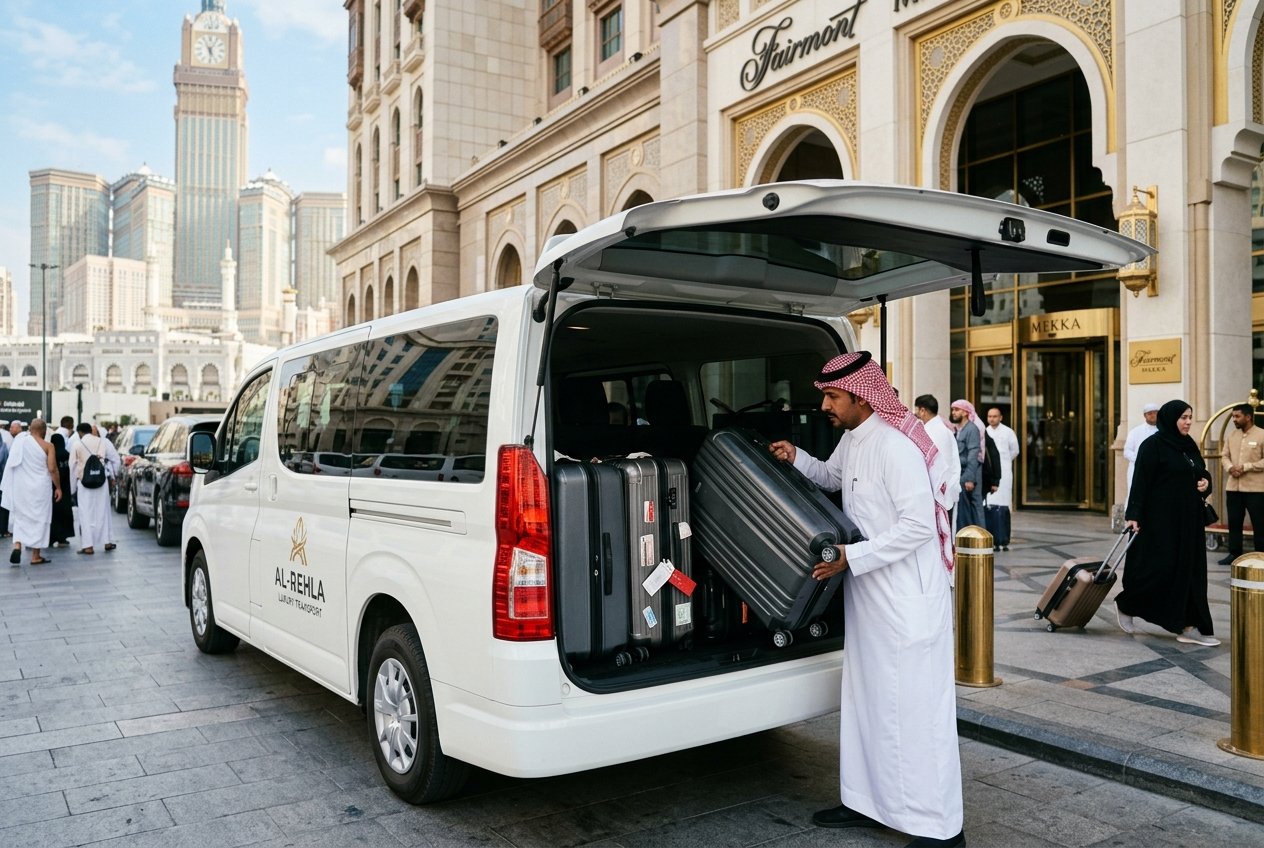
The vehicle allocation was changed to a Toyota HiAce before any confirmation was sent to the family. The HiAce was selected for two specific reasons: its side-loading configuration allowed the folded wheelchair to be stored flat in the dedicated luggage area without occupying any passenger seating, and its entry step height is lower than the Staria, making it more accessible for a passenger rising from a wheelchair.
The driver assigned to this booking was briefed in advance — not with a generic instruction to "be patient," but with specific information: the grandmother's post-surgical status, which side she found easier to lead with, the fact that the family would be fatigued from a night flight, and that the children would need to be seated quickly so the grandmother could board without the group crowding the entrance.
He arrived at Terminal 1 thirty minutes before the scheduled landing — accounting for the possibility that immigration clearance for a group of nine might take longer than average. Rather than positioning himself at the main arrivals exit, he chose the far side of the hall where foot traffic is thinner and the approach from the baggage reclaim area is more direct. This meant the family would not have to navigate around other waiting passengers or competing taxi drivers.
When the family emerged, he identified them before they spotted him, moved toward them immediately, and offered to take the wheelchair directly. Boarding was completed before the luggage was loaded — so the grandmother was already seated and comfortable by the time the bags were secured.
The group was at their hotel in the Aziziyah district by 05:55 — within 95 minutes of landing.
The family returned for Umrah twice in the following fourteen months — both times booking the same service and requesting the same driver by name. On their second trip, the grandmother wanted to include a visit to Jannat al-Mualla, the historic cemetery near Masjid al-Haram where Sayyidah Khadijah (RA) and members of the Prophet's ﷺ family are buried. A Makkah Ziyarat tour was arranged around her pace, with the driver adjusting the itinerary at each stop based on how she was feeling.
The eldest daughter, who had made the original booking, sent the following message after the first trip: "My parents said the driver was the most patient person they met on the entire trip."
If you are travelling with elderly parents, a grandparent recovering from surgery, or anyone with limited mobility, include that information in your first WhatsApp message — not as a secondary detail, but as the primary context for your booking.
Vehicle selection, driver briefing, pickup positioning, and luggage loading sequence are all adjusted based on this. For a family travelling at 04:00 after an international flight, the difference between a pre-briefed driver with the right vehicle and a generic booking is the difference between a dignified arrival and an unnecessarily difficult one.
There is no surcharge for mobility-specific adjustments. It is part of the service, and it requires advance notice — not day-of improvisation.
An Indonesian family of five arrived at Terminal 1 at 14:30 in July — a mother, a father, and three children aged five, eight, and eleven. The booking had been made two weeks in advance via WhatsApp in English, with a note that the children had never travelled to Saudi Arabia before. July is the most demanding month for airport arrivals at King Abdulaziz International Airport: the outside temperature on the day of this transfer was 43°C, with direct sun and no shade between the terminal exit and the vehicle bays.
For children who have grown up in a tropical but humid climate — where 33°C feels oppressive — the sudden transition to dry 43°C desert heat at mid-afternoon is physically shocking. Disoriented children, fatigued parents, and a 90-minute drive ahead is not an ideal combination. The standard airport pickup process — wait outside, load luggage, then board — would have exposed three young children to peak summer heat for approximately four to six minutes.
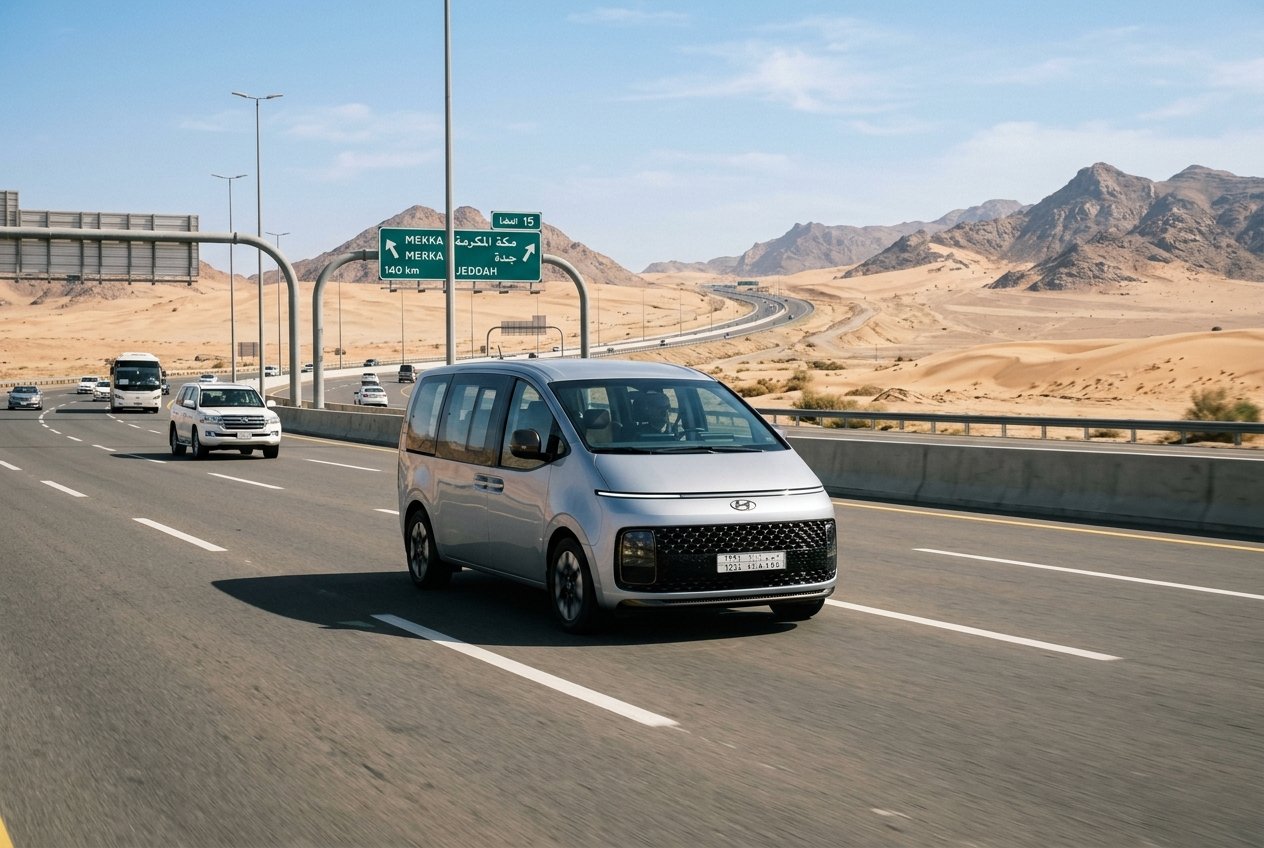
The coordinator flagged the summer arrival with young children when confirming the booking. The vehicle — a Hyundai Staria, allocated for the family's luggage volume — was pre-cooled to 20°C before leaving the staging area and maintained at that temperature in a shaded holding bay within the airport's vehicle zone, rather than in the open-sun queuing area used by most private vehicles.
Cold water bottles — one per passenger — were loaded before pickup.
The driver's instruction was to collect the family from inside the air-conditioned arrivals hall rather than waiting at the outdoor kerb. This is a positioning difference of approximately 30 metres, but it eliminates the most uncomfortable part of a summer airport experience. The family walked from the cool arrivals building directly into a cool vehicle. Their total heat exposure between the air-conditioned terminal and the air-conditioned Staria was under 90 seconds.
The children were asleep within 20 minutes of departure. The parents had time to decompress before reaching Makkah.
The mother sent a review the following day. The sentence that captured what the service had done was not about the driver's friendliness or the vehicle's cleanliness — though she mentioned both. It was: "We did not have to worry about our children even for one moment."
For parents travelling with young children on a spiritually focused trip, the ability to stop worrying about logistics is not a minor comfort. It is the entire point of pre-booking.
The family asked during the trip whether we covered Madinah Ziyarat tours. A tour was arranged for their second week, and they extended their Madinah stay by two days as a result.
Travelling with children between May and September requires different pickup logistics than off-peak travel. When you book a summer arrival, mention it explicitly — not just the date, but the time of day and the ages of your children.
We pre-cool all vehicles before summer pickups. We use shaded vehicle bays. We position drivers inside the terminal building, not outside. These are standard operating adjustments — but they require knowing the details of your arrival in advance.
If you are planning summer Umrah with young children, book early. Summer is the lowest-demand period for Umrah — prices are lower and availability is higher — but the logistics require more care, not less.
Two families — one from New York, one from Toronto — had been travelling together on a shared Umrah itinerary. They had booked a Toyota HiAce for an eleven-passenger Makkah to Madinah transfer, scheduled for departure at 12:15, timed around their confirmed 12:00 hotel checkout from a property in the Aziziyah district.
At 11:40 — thirty-five minutes before both the checkout and the scheduled departure — the hotel informed them that their extension request, submitted two days earlier to extend one of the rooms for an additional night, had been approved. The approval was welcome news for the family staying on, but it created an immediate complication for the group's shared transport: the confirmed checkout had shifted from 12:00 to 13:00, and the departure was now 45 minutes past the original schedule.
This type of last-minute change is common in Makkah during peak season. Hotels operating at high occupancy have unpredictable room turnover, and checkout confirmations can shift on short notice in either direction. Most transport services — particularly those operating on fixed departure schedules — cannot absorb an unannounced hour's delay without a rebooking fee or, in some cases, without cancelling the booking entirely.
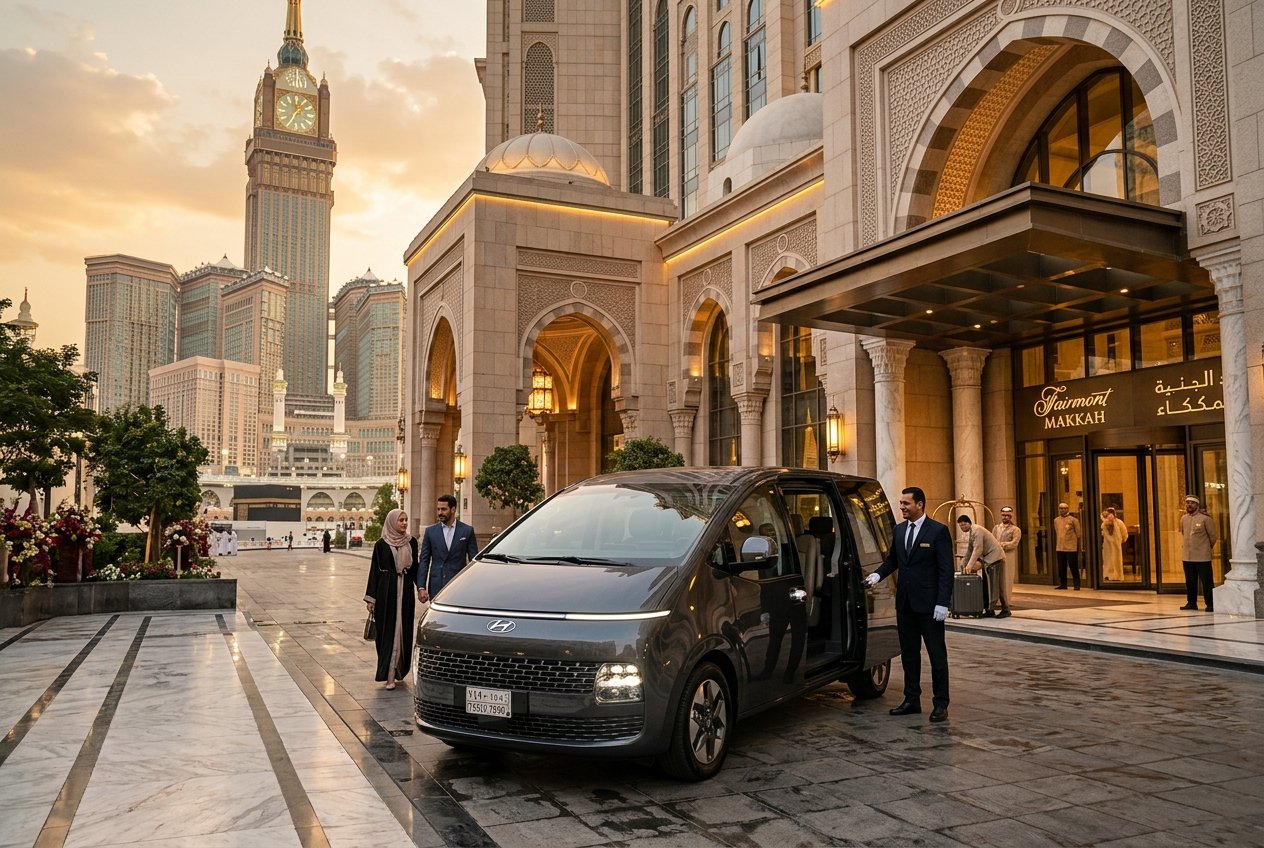
The group leader — the father from the New York family — sent a WhatsApp message at 11:42: "Hotel pushed checkout to 1pm, can we push our transfer too?"
The coordinator confirmed within three minutes: yes, the transfer would move to 13:15, no surcharge, same vehicle, same driver.
The driver, who had already positioned himself in the hotel drop-off bay, was notified and remained in place. The additional wait was 55 minutes from his original arrival time. He used the time to perform Dhuhr salah in the hotel lobby mosque.
Departure took place at 13:08 — seven minutes ahead of the revised schedule. The group loaded without rushing. Luggage for eleven passengers — which included a significant number of bags plus two strollers — was secured in under ten minutes. The driver took the Route 80 Haramain Expressway toward Madinah.
Two prayer stops were made en route — both at service areas with prayer facilities, selected by the driver based on timing rather than convenience. A single rest stop followed approximately halfway. The group arrived at their Madinah hotel at 18:30.
The group leader submitted a detailed review that mentioned three things: the driver's willingness to stop at every salah time without being asked, the seating layout of the HiAce ("three seats in front, then three, then four in the back — everyone was comfortable"), and the fact that despite eleven passengers and more than a dozen bags, nothing was left behind and no one in the group expressed a single complaint during the entire journey.
He sent a separate message to the coordinator after arrival: "Just wanted to say thank you for sorting the checkout situation so quickly. You made it easy."
Both families booked return transfers — Madinah to Jeddah Airport — through the same service for their departure.
Hotel checkout times in Makkah and Madinah during Ramadan and peak season are genuinely unpredictable. Requests submitted two days in advance may be confirmed at 11:40 on departure morning. Plans that were fixed the night before can shift by an hour.
Our transfers do not operate on rigid departure windows. If your checkout moves by 45 minutes, your departure moves by 45 minutes. If you are travelling in a group with multiple families sharing a single vehicle, the same flexibility applies to the whole group — not just one booking.
The only requirement is that you tell us as early as possible. A 40-minute notice period is workable. A 5-minute notice period is harder to manage, though not impossible.
For groups travelling between cities, communicate openly with us throughout the day of departure. WhatsApp is monitored continuously.
A husband and wife from Karachi — both in their mid-seventies — arrived in Madinah as the first stop of their Umrah trip, following the Sunnah itinerary. The booking had been made by their son, who lives in London and was coordinating the entire trip remotely. His message was brief and direct: "My parents are both elderly. My father has a heart condition and gets tired quickly. My mother has knee pain and cannot walk far. This may be their last Umrah. Please take care of them."
They had no family member travelling with them. The son had arranged for a contact in Madinah to meet them at the airport and stay in communication, but the transport — from Madinah Airport to their hotel, then two days later for a Ziyarat tour, then the following morning for the Madinah to Makkah transfer — was entirely in our hands.
The couple spoke Urdu. They had limited English and no Arabic beyond the basic phrases required for prayer. They were travelling on Pakistani passports and had performed Umrah once before, approximately thirty years earlier.
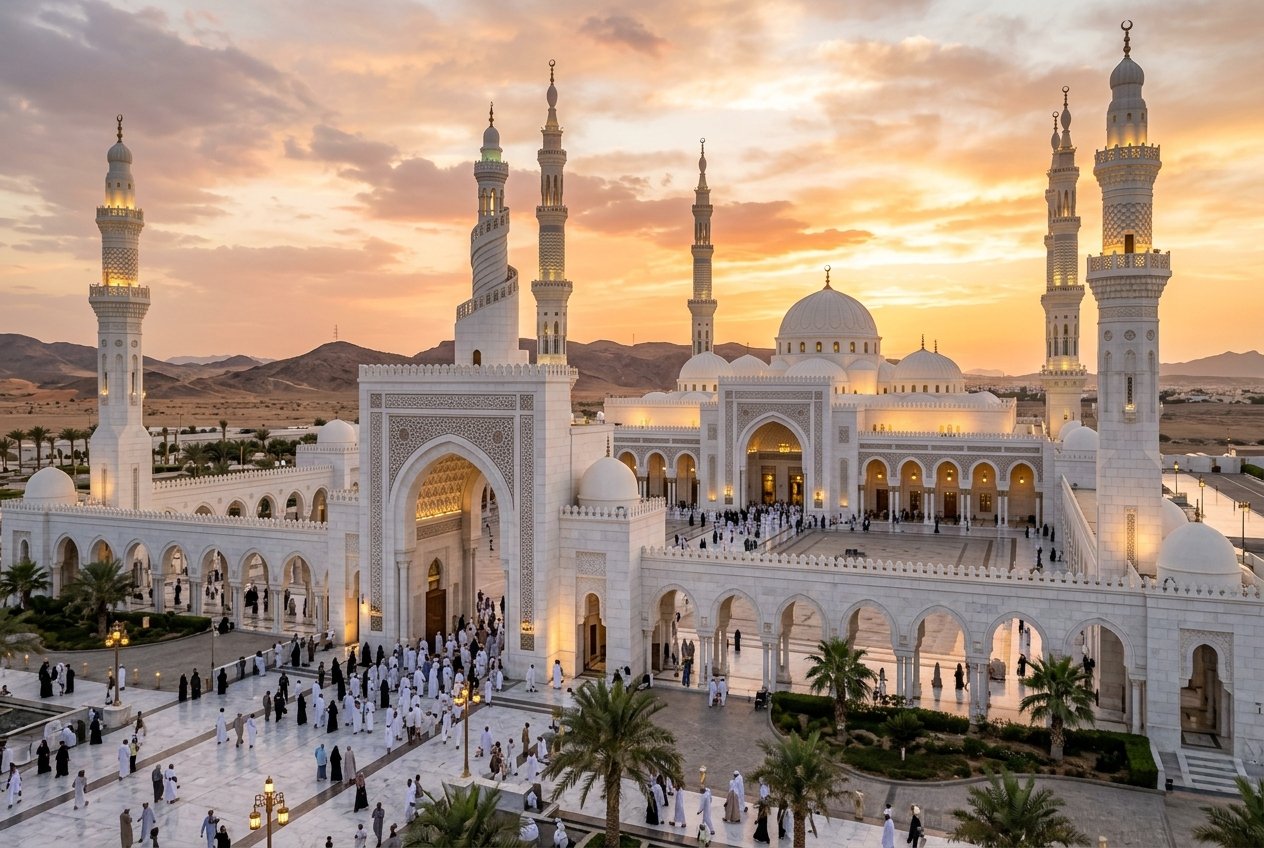
The Madinah Airport pickup was straightforward. The driver — Urdu-speaking, specifically requested by the coordinator for this booking — collected them from arrivals and delivered them to their hotel in the Nabawi district within 35 minutes. He introduced himself in Urdu, confirmed their hotel name, and helped carry their bags to the reception desk.
Two days later, the same driver collected them from the hotel for a Madinah Ziyarat tour. The itinerary had been designed around the husband's stamina: Masjid Quba first, while energy was highest, because the walk inside Quba's courtyard is short and the prayer carries a reward equivalent to Umrah. Masjid Qiblatain second — almost entirely vehicle-based with a brief entry. Mount Uhud third, with the driver accompanying them to Jannat al-Shuhada at a walking pace the husband could sustain. Jannat al-Baqi fourth, for the wife, who had specifically wanted to visit the graves of the Prophet's ﷺ companions and family members. The tour was completed in three hours and forty minutes. The husband rested in the vehicle during the longer walks.
Before the Madinah to Makkah transfer the following morning, the driver arrived at 08:00 — specifically to allow an unhurried departure before the midday heat. The route passes Masjid Dhul Hulayfah — the Miqat point for pilgrims travelling from Madinah to Makkah. The couple had been in contact with their son in London the night before about whether they were physically well enough to enter Ihram and perform a full Umrah upon arrival in Makkah. They had decided they were.
The driver stopped at Bir Ali, waited for 55 minutes while the couple performed wudu, changed into Ihram, and prayed two rak'ah at the Miqat mosque. He did not suggest they hurry. He did not wait by the vehicle — he waited at the mosque entrance where they could see him, so they would not feel uncertain about where to go when they were ready.
They arrived in Makkah at 13:30. The husband required a brief rest before proceeding to the Haram. The driver dropped them at their hotel, carried the bags upstairs with the help of the hotel porter, and confirmed with the son by WhatsApp that the couple had arrived safely.
Three weeks after the trip, the son in London sent a message to the coordinator. It read: "My parents said the driver treated them like family. My father cried when he talked about the Miqat stop — he said he was worried he wouldn't have the strength to do it properly, and the driver gave them all the time they needed without making them feel like a burden. JazakAllah khair for looking after them."
The couple completed their Tawaf and Sa'i. They performed a full Umrah. It may have been their last — but it was complete.
The son has since referred four families from his community in London to our service. He specifically tells them to mention his parents' booking when they make contact.
When elderly parents travel without family, the responsibility transferred to the transport service is significant. The best outcomes happen when the family member coordinating the booking provides complete context upfront — health conditions, language, pace, specific Ziyarat preferences, and what the journey means to the travellers.
A driver who knows these details in advance can plan every stage of the trip with them in mind. A driver who receives a standard booking with a name and a pickup time cannot.
If you are organising Umrah transport for elderly parents from abroad, do not compress the booking into the minimum required information. Tell us everything that matters. We will build the logistics around it.
These four cases represent a fraction of the situations our drivers and coordinators have navigated. What they have in common is not the type of challenge — it is the principle behind how they were handled: the details communicated at the time of booking determine the quality of what happens on the day.
If you are planning an Umrah trip and have circumstances that feel complex — a large group, elderly passengers, young children, a health condition, a tight schedule, a first-time pilgrim who does not know the routes — share those details when you book. They are not complications. They are information. And they allow us to do the job properly.