Home > Madinah Taxi Service > Madinah to Makkah Taxi
A private taxi from Al-Madinah Al-Munawwarah to Makkah Al-Mukarramah costs SAR 450 for a Toyota Camry (4 passengers), SAR 600 for a Hyundai Staria (7 passengers), SAR 900 for a GMC Yukon XL, SAR 750 for a Toyota HiAce (11 passengers), and SAR 1,100 for a Toyota Coaster (19 passengers). The journey covers 435 km and takes 4.5 to 5 hours. A free Miqat stop at Masjid Dhul Hulayfah (Bir Ali) is included for all pilgrims performing Umrah.
This is the journey that begins your Umrah.
Pilgrims travelling from Madinah to Makkah are not simply crossing 435 km of Saudi desert — they are moving toward the Haram to stand before the Kaaba, to perform Tawaf around the House of Allah, to walk between Safa and Marwah in the footsteps of Sayyidah Hajar (AS). The journey carries a gravity that most transportation providers never acknowledge.
Before you enter Makkah, you must stop at the Miqat.
This is not optional. It is not a technicality. Masjid Dhul Hulayfah — known widely as Bir Ali or Abyar Ali — is the designated Miqat boundary for pilgrims travelling from the direction of Madinah. It sits approximately 9 km south of Madinah city, on the road toward Makkah. Every pilgrim intending to perform Umrah must stop here, enter the state of Ihram, and make their intention (niyyah) before continuing.
This stop is included in every Madinah to Makkah taxi booking we provide. No extra charge. No time limit. Your driver knows the mosque, knows the parking, and knows what you need when you are there. He will wait at the entrance where you can see him.
What is Miqat?
Miqat (plural: Mawaqit) refers to the sacred boundary stations designated by the Prophet Muhammad ﷺ as the points beyond which no pilgrim intending Umrah or Hajj may pass without having entered the state of Ihram. There are five Miqat boundaries positioned around Makkah, each serving pilgrims approaching from a different direction.
Which Miqat applies to Madinah pilgrims?
Masjid Dhul Hulayfah — commonly called Bir Ali or Abyar Ali — is the Miqat for pilgrims travelling from Madinah and the north. It is the most distant of all five Miqat points from Makkah, approximately 426 km from the Haram. The Prophet ﷺ established this boundary, and it has been the designated Miqat for Madinah pilgrims since the earliest days of Islam.
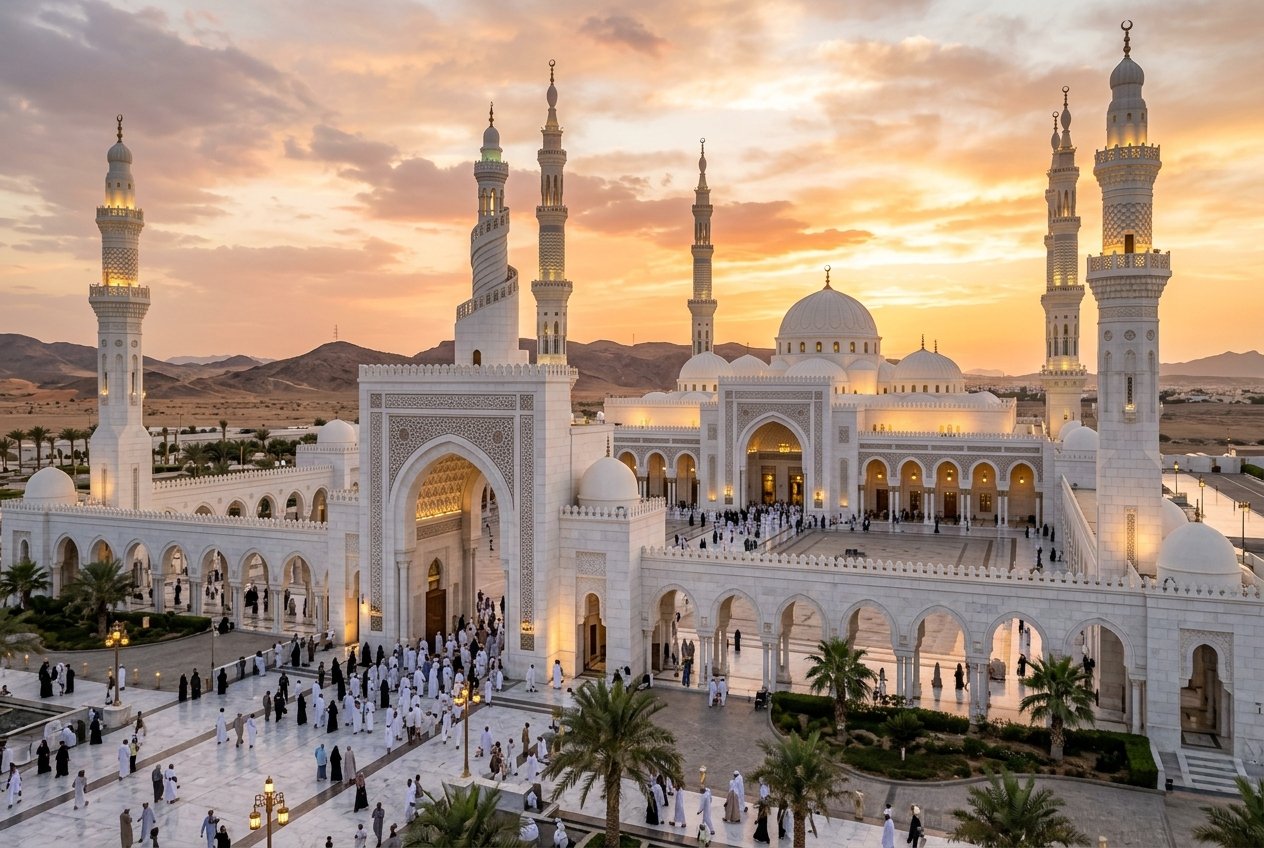
When your driver arrives at Masjid Dhul Hulayfah, he parks and tells you there is no rush. Here is what you do:
1. Perform ghusl or wudu — there are ablution facilities at the mosque.
2. Change into Ihram garments — the mosque has separate changing areas for men and women.
3. Offer two rak'ah of prayer — specifically for the intention of Ihram.
4. Make your niyyah — your verbal intention to perform Umrah.
5. Recite the talbiyah: Labbayk Allahumma labbayk. Labbayk la shareeka laka labbayk. Innal hamda wan-ni'mata laka wal-mulk. La shareeka lak.
From this moment, the rules of Ihram apply. Your driver understands this. He will not play music unless you ask. He will drive with care and calm. He will stop for Salah without being asked.
How long does the Miqat stop take? Allow between 30 and 60 minutes for most pilgrims. Families with young children or elderly members may need a little longer. We have waited at Bir Ali for over an hour for pilgrims who needed more time. No one was rushed.
We collect from every hotel zone in Madinah's Nabawi district. Share your hotel name when booking and your driver arrives at your lobby at the confirmed time. He loads the luggage. If you have elderly passengers, they board first.
Common pickup zones:
• Central Nabawi district — hotels within the immediate Nabawi area, Anbar district, Sahl Harun street
• Al-Anbariyyah Market corridor — mid-range hotel zone popular with South Asian pilgrims
• King Fahd Road corridor — hotels further from the mosque, popular for longer stays
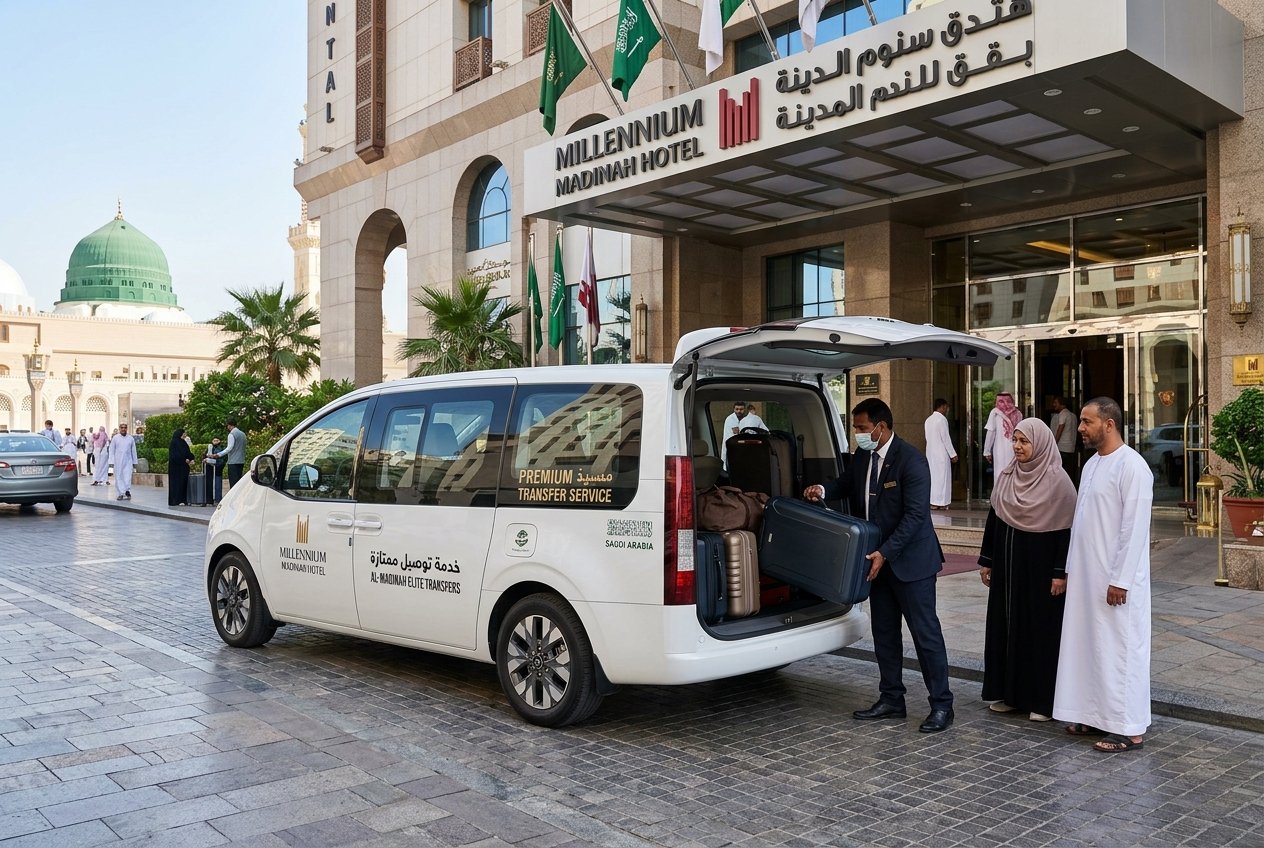
If your Madinah hotel is in a narrow street with vehicle access restrictions — several exist in the central zone near the mosque's eastern gates — your driver will navigate to the closest permitted point and carry bags from there. He has done this hundreds of times.
The stretch of highway between Madinah and Makkah has its own traffic rhythms, and knowing them helps you plan a more comfortable journey.
Early morning (after Fajr) is consistently the best window. Roads are clear, temperatures are manageable, and you arrive in Makkah before the midday heat. For pilgrims arriving at their Makkah hotel with enough time to rest before Asr, a post-Fajr departure from Madinah is ideal.
Avoid mid-Friday departures if your schedule permits. The section of highway approaching Makkah, particularly through the Al-Hada junction, can experience significant congestion on Friday afternoons as Saudi families and resident pilgrims travel into the city for Jumu'ah and remain through the afternoon.
During Ramadan, departures between Iftar and Isha see the highest road volumes on this route — pilgrims who fasted all day and are now making their way to Makkah for Tarawih prayer. The road is busy but manageable. Our drivers know it well in all seasons.
The Madinah to Makkah journey passes through some of the most historically resonant landscape in the Islamic world.
The first significant stretch out of Madinah takes you south through the outskirts of the city and past the district of Quba — site of Masjid Quba, the first mosque in Islam. If you have not yet visited Masjid Quba during your stay in Madinah, your driver can arrange a brief stop as you depart, though this would typically be pre-arranged at booking.
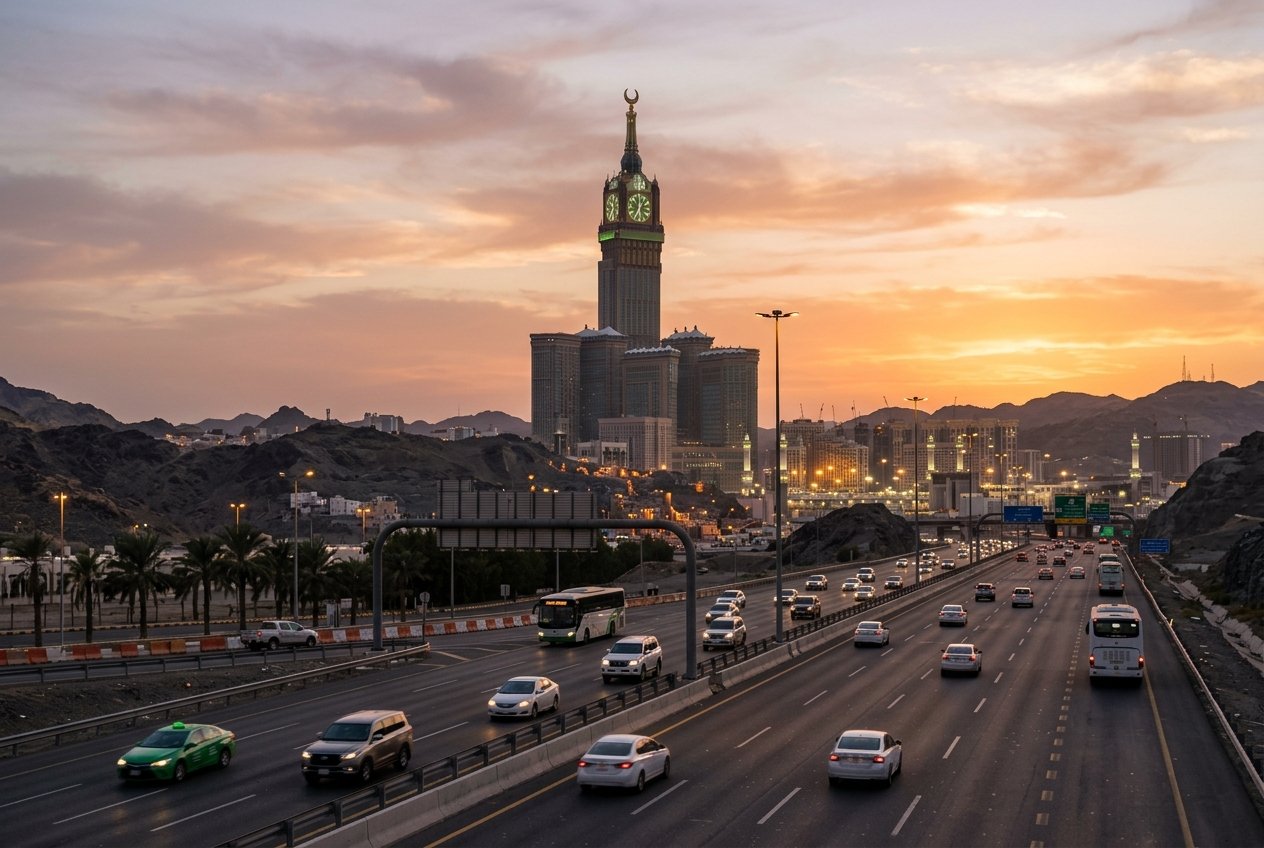
As you travel south, the terrain transitions from Madinah's volcanic black basalt plains — the Harrat — into open desert before entering the Hejaz mountain passes approaching Makkah. The landscape has a raw, ancient quality. Pilgrims who make this drive after days of worship in Madinah often describe the desert silence from the vehicle window as a natural extension of that contemplative state.
Approximately 60 km north of Makkah, you cross into the higher terrain of the Hejaz range. The air begins to change. Then — as the city of Makkah draws into view — the illuminated towers of the Abraj al-Bait appear above the horizon. For many pilgrims returning to Makkah after days in Madinah, this moment carries its own quiet weight.
All fares are per vehicle. All fares include the free Miqat stop at Masjid Dhul Hulayfah (Bir Ali). You pay the driver in cash upon arrival at your Makkah hotel.
| Vehicle | Passengers | Luggage | Fare (SAR) | Best for |
|---|---|---|---|---|
| Toyota Camry | Up to 4 | 3 large bags | SAR 450 | Couples, small families |
| Hyundai Staria | Up to 7 | 8–10 large bags | SAR 600 | Most popular — families and groups |
| GMC Yukon XL | Up to 7 | 6–8 large bags | SAR 900 | VIP travel, premium comfort |
| Toyota HiAce | Up to 11 | 14–16 large bags | SAR 750 | Extended families, mosque groups |
| Toyota Coaster | Up to 19 | 24+ large bags | SAR 1,100 | Large delegations |
Upon arrival in Makkah, your driver delivers you directly to your hotel. We serve every hotel district in Makkah Al-Mukarramah:
• Aziziyah district (24243) — the largest and most popular hotel area for UK and South Asian pilgrim families
• Ajyad district (21955) — Intercontinental, Hilton Suites, Dar al-Tawhid, and central properties
• Abraj al-Bait / Clock Tower area — Fairmont, Swissotel, Raffles, and Tower hotels near the Haram entrance
• Kudai district (24352) — growing hotel zone southeast of the Haram
• Rusaifah and Jarwal — budget and mid-range properties for long-stay pilgrims
If your hotel is within the restricted vehicle zones near the Haram gates during prayer times, your driver knows the closest permitted access point and will carry luggage the remaining distance. He does not drop at the street and leave.
Pilgrims sometimes assume the Makkah-to-Madinah and Madinah-to-Makkah transfers are identical journeys in opposite directions. Logistically, the roads are similar. But the pilgrim making each journey is in a completely different position.
The pilgrim travelling Makkah to Madinah has completed their Umrah. They are at peace, moving toward the city of the Prophet ﷺ for Ziyarat and the blessing of the Rawdah. They are not in Ihram. They do not have a Miqat obligation for this direction.
The pilgrim travelling Madinah to Makkah is approaching the Haram to perform Umrah. They must enter Ihram. They carry the weight of intention and anticipation. They may be nervous — particularly first-timers who are unsure about the Miqat process. They need a driver who understands what this moment means.
This is why we treat these as two different journeys, not one route operated in both directions.
"The driver stopped at Bir Ali without us even asking. He said: 'We have arrived at Masjid Dhul Hulayfah — you have as long as you need.' My father cried. He was worried he wouldn't have the strength to perform the Ihram properly and the driver gave him all the time he needed without making us feel like a burden. JazakAllah khair."
"Driver Farhad was punctual, very professional, and looked after all our needs throughout the journey from Madinah to Makkah. The Miqat stop was handled perfectly. I would definitely recommend this service."
Tell us:
Your Madinah hotel name and preferred departure time
Number of passengers and bags
Vehicle preference (or let us recommend based on your group size)
Whether any passengers have mobility needs (we adjust the vehicle allocation)
We confirm your booking with your driver's name, photo, and contact number — insha'Allah within 60 minutes. Zero advance payment. You pay in cash when you reach your Makkah hotel.
Our only official WhatsApp: +966 55 375 2182
A private taxi from Madinah to Makkah costs SAR 450 for a Toyota Camry (4 passengers), SAR 600 for a Hyundai Staria (7 passengers), SAR 900 for a GMC Yukon XL, SAR 750 for a Toyota HiAce (11 passengers), and SAR 1,100 for a Toyota Coaster (19 passengers). All fares are per vehicle, door-to-door, with the free Miqat stop at Bir Ali included.
Yes — automatically, without needing to be asked. Masjid Dhul Hulayfah (Bir Ali / Abyar Ali) is approximately 9 km south of Madinah on the Makkah road. Your driver stops, parks, and waits while you perform wudu, change into Ihram, offer two rak'ah, and make your niyyah. There is no time limit. This stop is included in your fare at no extra charge.
Most pilgrims require 30 to 45 minutes at Masjid Dhul Hulayfah to complete wudu, change, pray, and make their intention. Families with young children or elderly members may take longer. We have waited over an hour without any issue. Your driver will be at the mosque entrance where you can see him when you are ready.
Departing after Fajr prayer is the optimal window — roads are clear, temperatures are manageable, and you arrive in Makkah before the heat of the day. Avoid mid-Friday departures when possible, as the approach to Makkah experiences peak congestion on Friday afternoons. During Ramadan, post-Iftar departures are heavily congested.
We serve all Makkah hotel districts including Aziziyah (24243), Ajyad (21955), the Abraj al-Bait / Clock Tower area, Kudai (24352), Rusaifah, and Jarwal. Your driver delivers directly to your hotel lobby. If vehicle access restrictions apply near your hotel, he carries luggage from the nearest permitted access point.
No. Zero advance payment. You pay the driver in cash when you arrive at your Makkah hotel. No online payment, no bank transfer, no deposit of any kind before the journey.