Home > Madinah Taxi Service > Madinah to Badr Ziyarat Taxi
Badr (Ghazwat Badr) is approximately 150 km southwest of Al-Madinah Al-Munawwarah via the main Madinah–Jeddah highway. A private full-day return taxi from Madinah to Badr costs SAR 450 for a Toyota Camry (4 passengers) and SAR 600 for a Hyundai Staria (7 passengers). The one-way drive takes 2 to 2.5 hours. Most pilgrims spend 2 to 3 hours at the Badr sites before returning to Madinah, making a total day of 7 to 8 hours. All fares are fixed, per vehicle, include waiting time, and require zero advance deposit.
The valley of Badr holds a place in Islamic history that cannot be overstated.
On 17 Ramadan, 2 AH (13 March 624 CE), 313 Muslim believers — short of arms, outnumbered more than three to one, many without proper weapons or mounts — faced the full military force of the Quraysh of Makkah at this valley southwest of Madinah. What happened that day was not a military accident. The Prophet Muhammad ﷺ described the Companions of Badr as the best of Muslims. Allah ﷻ sent angels to fight alongside the believers. The victory was decisive and its significance — for the survival and future of Islam itself — is affirmed across the Quran and Sunnah.
For pilgrims who know this history, visiting Badr is not a sightseeing trip. It is a form of connection — to the Companions who gave everything, to the events that shaped the first Muslim community, to the valley that Allah ﷻ chose as the site of His help.
We drive this route regularly, carrying pilgrims who make the journey for exactly this reason. What they find when they arrive — the landscape, the scale of the valley, the graves of the martyrs — consistently affects them more deeply than they expected. Our door-to-door private taxi service from Madinah allows you and your family to make this deeply spiritual journey in calm, unhurried contemplation.
The Battle of Badr took place on 17 Ramadan, 2 AH — the seventeenth day of the holy month, in the second year of the Hijri calendar, corresponding to 13 March 624 CE.
The Quraysh army, led by Abu Jahl, numbered approximately 950 to 1,000 warriors — well-equipped, with horses and armour. The Muslim force numbered 313, including 86 Muhajiroon (those who migrated from Makkah) and 227 Ansar (the Muslims of Madinah). They had access to 70 camels and 2 horses between them.
The victory belonged to the believers. Seventy Quraysh leaders were killed, including Abu Jahl. Seventy were taken prisoner. Among the Muslim casualties were fourteen martyrs — six Muhajiroon and eight Ansar — whose graves remain preserved at the site to this day.
In Surah Al-Anfal, Allah ﷻ also describes the divine host sent to reinforce the ranks of the believers:
The Companions of Badr — the 313 who fought that day — hold a unique, unshakeable rank among the righteous. In a celebrated hadith recorded in Sahih al-Bukhari, the Prophet ﷺ said of them: "Do whatever you wish, for Allah has forgiven you."
For a pilgrim who understands Badr — who has read Surah Al-Anfal, who knows the names of the Companions, who grasps what was at stake for the early Ummah — standing in the valley where this battle occurred is not an ordinary excursion. The natural desert topography is largely unchanged. The positioning of the dunes remains. The area of the wells is marked. And the resting places of the 14 martyrs are physically present before you.
The valley where the battle took place can be walked and observed from high vantage points. The scale becomes immediate and palpable on the ground — the strategic positioning of the Muslim camp near the water wells, the Qurayshi advance from the distant dunes (Al-Udwah al-Quswa), and the precise terrain where the initial single combats and the general clash unfolded.
Our experienced drivers understand the local geography and can point out the key landmarks mentioned in historical texts, allowing you to orient yourself within the landscape described in the Quran and Seerah.
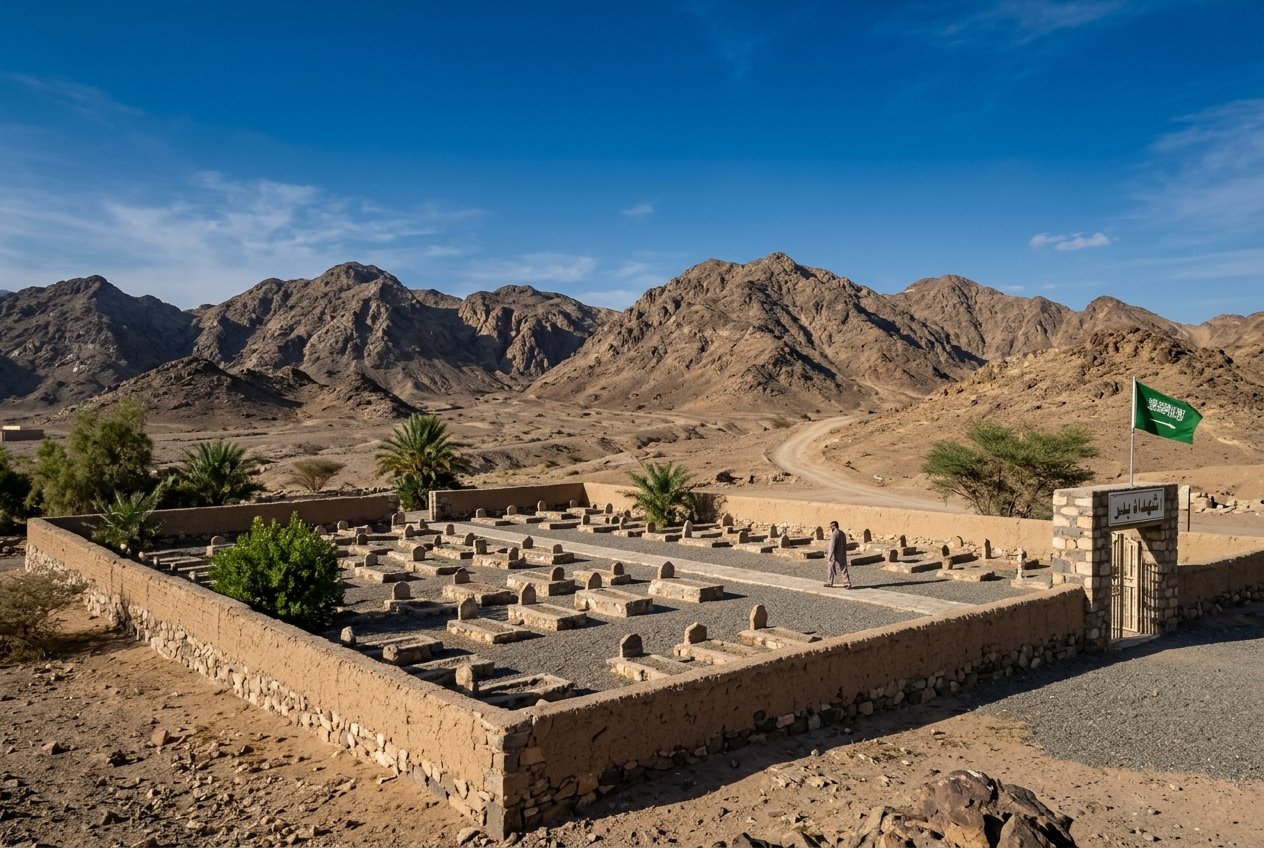
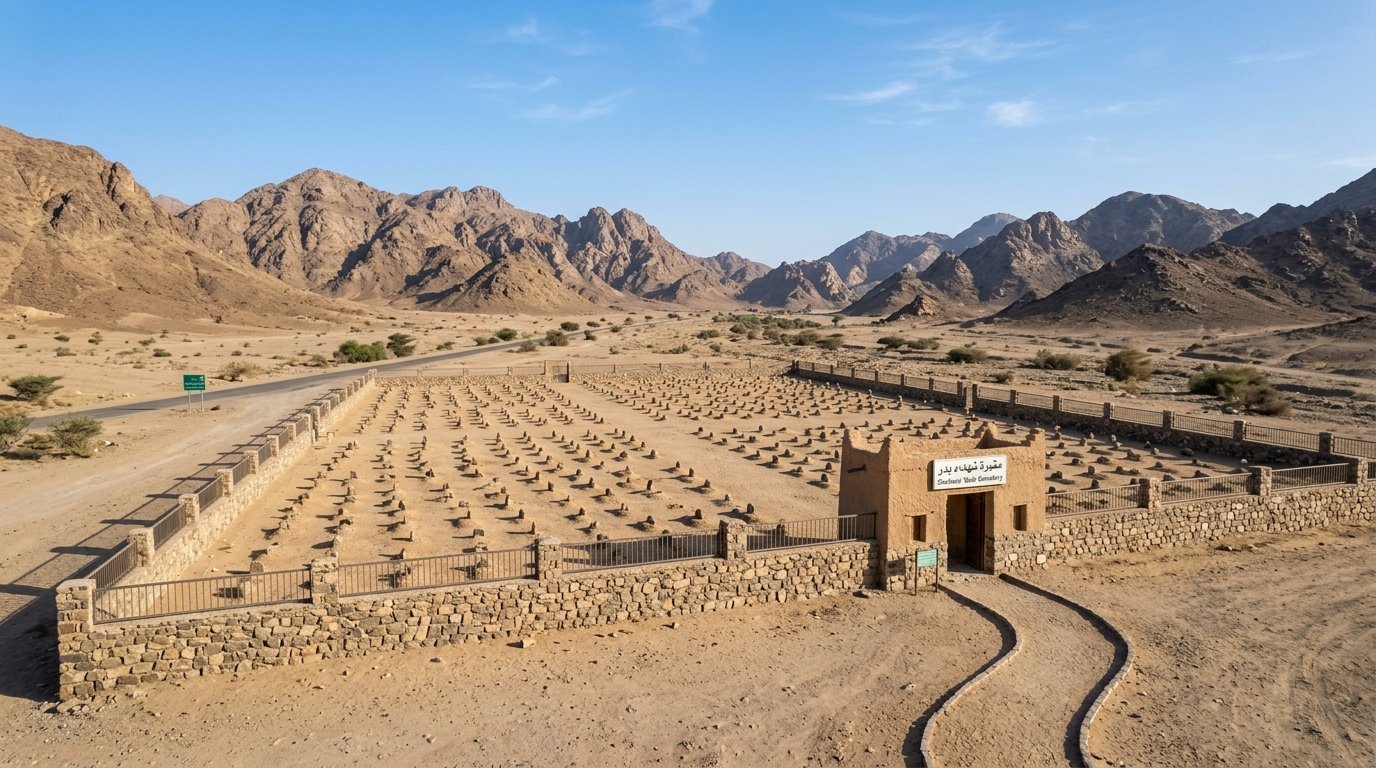
The graves of the 14 Muslim martyrs are marked and enclosed in a peaceful, walled compound near the main battlefield. This is typically the most moving, tearful part of the visit for pilgrims.
Standing at the graves of Companions like 'Ubaydah ibn al-Harith, Safwan ibn Wahb, and Mihja' (the first to be martyred) brings home the immense sacrifice that allowed the message of Islam to endure.
Visiting the cemetery, offering Salam upon these noble souls, and making heartfelt du'a is the core spiritual purpose of Ziyarat at Badr. We ensure our passengers have abundant, unhurried time at this sacred site.
The Badr Wells: Several ancient wells in the valley mark the historic water sources of the caravan route. Before the battle, the Prophet ﷺ positioned the Muslim army near the closest water supply upon the tactical advice of his Companion al-Hubab ibn al-Mundhir (RA), who recommended seizing the forward wells so the believers had water while denying it to the opposing force.
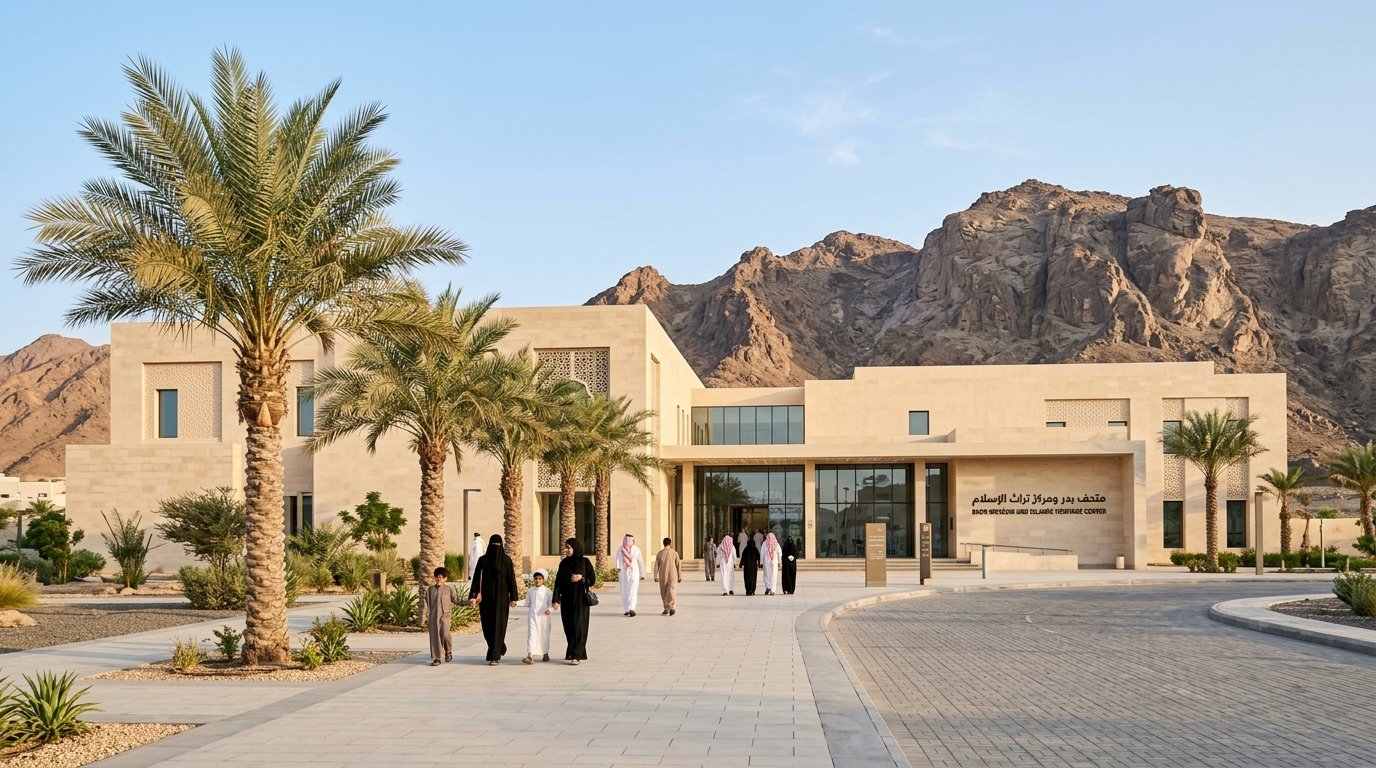
The Badr Museum: A purpose-built cultural museum near the site presents the history of Ghazwat Badr through maps, tactical models, and informative displays in Arabic and English.
The journey from Al-Madinah Al-Munawwarah to Badr heads southwest across Route 60 and the modern Madinah–Jeddah highway corridor. You leave the volcanic plains surrounding Madinah and travel through the scenic Hejaz desert, passing volcanic outcrops, rocky wadis, and ancient trade routes before descending into the palm oasis and sand dunes of Badr.
Your dedicated driver handles all logistics. He will comfortably stop for Salah at clean highway rest stops whenever prayer time arrives without needing to be asked. For the return leg, your vehicle and driver remain parked nearby; whenever your family has completed their du'a and reflection, you simply return to the car to head back to Madinah.
Pilgrims often ask if they can combine Badr with the standard Madinah city Ziyarat tour (Masjid Quba, Mount Uhud, Jannat al-Baqi, and the Seven Mosques) in a single day.
This structure is used by hundreds of our repeat families from the UK, Canada, and Pakistan. It allows you to return to Madinah in the mid-afternoon with enough energy to offer Asr, Maghrib, and Isha peacefully inside the Prophet's Mosque (Masjid An-Nabawi).
All fares are fixed, per vehicle, and cover the complete full-day return itinerary: Madinah hotel pickup, 150 km drive to Badr, all waiting time at the battlefield, martyrs' cemetery, wells, and museum (typically 2 to 3 hours), and safe return to your hotel lobby. Cash on return. Zero advance deposit.
While public SAPTCO regional coaches run between major cities, reaching the battlefield of Badr via public transport is notoriously difficult. Public buses drop passengers at the Badr highway intersection miles away from the historical battlefield and martyrs' cemetery, requiring you to find local cabs in the desert heat.
| Feature | Umrah Car Rentals (Private Taxi) | Public Bus / Regional Transit |
|---|---|---|
| Hotel Pickup & Drop | Direct pickup from your Madinah hotel lobby | Must take taxi to remote bus depot |
| Access to Historical Sites | Drives directly to Battlefield, Graves & Wells | Drops at distant highway junction |
| Waiting Time at Sites | Unlimited flexibility (driver waits for you) | Fixed rigid bus timetable |
| Travel Comfort | Private air-conditioned cabin for your family | Crowded seating with multiple stops |
| Prayer & Rest Stops | Stop anytime at clean highway facilities | Only stops at scheduled transit stations |
"I had read about Badr my whole life. Standing in the valley was completely different from reading about it. The graves of the martyrs are right there — just simple marked graves in the ground. I made du'a for a long time. I could not have imagined it would affect me the way it did."
"We went to Badr on our third day in Madinah, just our family in a private Staria taxi. The driver gave us as much time as we needed at every site without rushing. When we were ready to leave, we left. A peaceful, blessed day."
"Booking on WhatsApp was seamless. Our driver arrived at our hotel near Masjid An-Nabawi at 6:30 AM sharp. He was courteous, drove safely on the highway, and explained the landmarks of Badr clearly. Worth every riyal."
Common questions regarding the journey, timings, historical sites, and booking process for the Badr Ziyarat tour.
Approximately 150 km southwest via the Madinah–Jeddah highway. The one-way drive takes 2 to 2.5 hours on modern, paved multi-lane expressways.
The battlefield valley where the historic encounter occurred, the sacred cemetery of the 14 Muslim martyrs (Shuhada al-Badr), the ancient Badr Wells where the Prophet's ﷺ camp was established, and the modern Badr Museum exhibiting artifacts, maps, and bilingual historical context.
A half-day visit is possible but leaves little time for reflective Ziyarat at the graves or exploration of the battlefield. Because round-trip travel requires 4 to 5 hours, most pilgrims who visit Badr recommend allocating a 7 to 8 hour full day to avoid feeling hurried.
Depart after Fajr prayer, arriving at Badr around 08:30 before the heat of the day builds. The Badr Museum typically opens at 09:00. Morning visits are significantly more comfortable than afternoon visits, particularly between May and September.
Yes. The Battle of Badr took place on 17 Ramadan, 2 AH. For pilgrims performing Umrah during Ramadan, visiting Badr during the holy month — particularly around the 17th — carries immense spiritual significance. We strongly recommend booking well in advance for Ramadan trips.
SAR 450 for a Toyota Camry (up to 4 passengers), SAR 600 for a Hyundai Staria (up to 7 passengers), and SAR 750 for a Toyota HiAce (up to 11 passengers). All prices are per vehicle for the complete full-day return trip including waiting time.
No deposit is ever required. You pay the agreed fixed fare directly to your driver in cash upon returning safely to your Madinah hotel.
Yes. The modern town of Badr has grocery stores, bakeries, and local restaurants serving hot meals, tea, and bottled water. Your driver will gladly guide you to clean, reputable dining spots if requested.
Complement your Badr Ziyarat with our full suite of licensed private intercity transfers and guided city tours: